Sunday, February 12, 2012

NCTE/ALAN 2011


Why yes, I do realize it's 2012! But guess what I forgot about? That would be my blog...

With the world of social media, I have recently gotten a Twitter (follow me @lastingrosebud), Goodreads account (username: misscasabona), and started a website for my classroom where my students can stay current on homework, vocab words, extra credit, book reviews, and other resources.

Therefore, it is no surprise that along the way I have lost all sense of writing for my own, personal reasons. The highlight of 2011 for me was attending the NCTE and ALAN conventions in Chicago, IL. My first time in Chicago, and my 3rd annual attendance at the NCTE convention, left me with more resources and information than I could handle. I resorted to making a Google document to commemorate all that I learned during my trip, from the various teaching workshops.

For the second year in a row, I had the pleasure of meeting and conversing with educational advocate and teacher, Kylene Beers.


I promise to write more about the convention when I have some free time. For now, it's off to grade some student journals while watching the remainder of the Grammy's!

Sunday, September 25, 2011

Much More Than Staying Afloat

The pencils were sharpened, the posters were hung, the desks were arranged in the ever-inviting U-shape. The only thing missing were the students.
(Classroom Library and posters)

The days leading up to the first day of school were filled with anticipation, anxiety, and excitement. I was nervous about establishing a classroom culture, especially as a new teacher. My students, only eight years younger than me, had the potential to smell fear and eat me alive.

Many new teachers are probably just trying to stay afloat...but for me, I think I'm beyond that. I'm looking towards the future, end goals for the students, and my instruction. Our school functions on an understanding by design model, which is how I made my lessons while I was in college. The transition is relatively easy for me, so now I can build. I'm ready to try new things, make mistakes, and learn from my students. And the best news is that I still have 166 days of school left to do all this!
(My desk in the back office.)

Tuesday, July 26, 2011

Review of Kathryn Stockett's "The Help"

My rating: 5 of 5 stars

In her debut novel, Stockett paints the picture of a racially divided, not-so-equal Jackson, Mississippi. Every few chapters of the novel is told from a different perspective, alternating between maids Aibileen and Minny and the white daughter of a farm owner, Miss Skeeter. One of the best aspects of this novel is that it helps illustrate how historical events are connected and not merely isolated incidents. Beginning in 1962, the novel primarily follows the path of Miss Skeeter after she returns from college (husbandless) and finds that her maid Constantine has been fired by her mother. When Skeeter’s friend Holly begins to stir up racial tensions, Skeeter begins a dangerous mission to expose the truth of race relations in the South. Enlisting the help of neighborhood maids, Skeeter pens the maids’ stories as well as her own, showing how both kindness and hatred can simultaneously exist.


Wednesday, July 6, 2011

Thirteen Reasons Why You Should Read "Thirteen Reasons Why"


For those of you unfamiliar with Jay Asher's Thirteen Reasons Why, it is his debut novel in which he fictionally depicts the thirteen reasons why his character Hannah Baker commits suicide. When high school student Clay Jensen receives cassette tapes in the mail, on which Hannah records her reasons for committing suicide, Clay doesn't want to listen but at the same time can't put the tapes down.

Here are my thirteen reasons why I think you should read Thirteen Reasons Why:

13. The multi-faceted narration: We get the perspectives of Hannah and Clay intertwined at the same time. He provides details that Hannah doesn't always include and vice versa.
12. The intricately woven plot: Each of the thirteen reasons why Hannah commits suicide correspond with thirteen people and incidents. And guess what...every one of these is connected...the classic snowball effect.
11. The play/pause/stop buttons: Whenever Clay plays a tape, a little "play" button is printed in the novel. As readers we "watch" Clay push the pause and stop buttons, knowing he needs a break to process the information.
10. The map: Hannah had slipped a map into each person's locker who she mentions on the tapes. On this map she puts a pink star on various locations that the plans on referencing in her tapes. Clay goes on a journey to each location, as he attempts to cope with what he's hearing. A copy of the map is printed in the inside cover of the novel.
9. Peer Communications class: A class in the high school where students are supposed to be able to discuss any topics. But when someone drops a note about suicide in the discussion box, suddenly the class is not so open and friendly. This class provides a real lesson to teachers and other students that they need to be more receptive to serious issues.
8. The online tapes: If you go to www.youtube.com/Hannahsfriend13 you can listen to portions of the tapes, narrated by an actress. Remember this is a fictional story, but based on real issues.
7. Each chapter is a different side of the tape: As each person's story runs out, the end of the chapter signifies this end of the story, while also beginning to implicate the next person.
6. Clay Jensen: Throughout the whole novel Clay metaphorically beats himself up for not helping Hannah or realizing what she was going through. And for that, I find him admirable.
5. Small town life: As indicated by the map, this whole novel takes place in a small, nondescript American town. I like the fact that not too many details about the setting are given, because then each reader can visualize the town for themselves.
4. The novel takes place over the course of one day (or should I say night): Clay begins listening to the tapes when he finds them after school one day, and he doesn't stop listening until well into the night. He travels from location to location pretty much without being bothered.
3. The fast pace: Since the novel takes place in only one night, and since each chapter is a different side of the tape, the novel is quite fast-paced. I couldn't put the book down and read the entire thing in one sitting.
2. The suspense: As the story unfolds, my brain tried to put the pieces o
f the story together, but I simply couldn't forget the connections myself. I needed Hannah to tell me the story.
1. Teen suicide can be prevented, and this book will emotionally charge people into action...or at least into being aware what some of the signs of suicide are. As Ha
nnah says in the novel, "When you mess with one part of a person's life, you're messing with their entire life." People need to be aware that bullying or teasing or anything of that nature affect others.

You can view the book trailer that I created for the novel at the following link:

Also, check out Jay Asher's website for the book:


Saturday, June 25, 2011

I'm Back!

Sorry for the brief hiatus, but the end of the school year was super busy especially with graduation and job interviews! Speaking of interviews, I got a job in Mount Olive and will be teaching 9th grade English next year! Some of the novels I will be teaching include: Romeo and Juliet, To Kill a Mockingbird, Oedipus Rex, Great Expectations, and 12 Angry Men.

Thanks to the public domain, I was able to download 12 Angry Men, Great Expectations, and Oedipus Rex for free. I've never actually read these three works in their entirety, so I'm in for a new experience with some old classics. I remember my text book in school had an excerpt from Great Expectations, so our teacher had us read that instead of the whole novel. As opposed to these three texts which I haven't fully read, To Kill a Mockingbird you may remember was one of the books I taught while I was student teaching. Hopefully I'll be able to exert some creative control over this unit and incorporate the detailed scrapbook project that I had my seventh and eighth grade honors students complete this year. Apparently the ninth grade teachers all teach the same units at the same time, so I'm hoping I'll still have the opportunity to demonstrate my own creativity. Time to start reading and brainstorming lesson plan ideas!

Also this summer, in addition to planning for the upcoming school year, I am trying to read as much YA Lit as possible. My friend from TCNJ encouraged me to register for goodreads.com, so that I can track which books I've read and write reviews for the books as well. In a Microsoft Word document I am also storing a copy of my reviews for each novel, hoping to develop some sort of classroom resource for next year. This way, when someone asks for a book recommendation, I can provide them with a short summary and honest feedback. I've managed to read a lot of books already this summer and am currently finishing up Pride and Prejudice and Zombies. I'm hoping to finish reading Star-Crossed by Josephine Angelini next, a novel with a Romeo and Juliet type romance set in the present day, with elements of Greek mythology thrown in. I might even be able to incorporate passages from this book into my Romeo and Juliet unit if I find the novel useful.

Now back to my heavy duty reading list.

Wednesday, April 20, 2011

Poetry Survey Using Google Forms

For my LIT 388 class, Contemporary Literature, with Professor Carney, we have an extra credit assignment where we can read poems to three different people, talk to them about the poems, and then write a response. I chose Sylvia Plath as the poet I wish to discuss with my friends and family; however, I wanted to also have more to write about for my response survey, so I did the following using Google Forms:

If you have a Google account, then you can use the Google Documents feature to create presentations, spreadsheets, documents, etc. One feature of Google Documents is to create a form, in which you can design the layout of the form, and ask a variety of questions, ranging from multiple choice to short answer. You have the option of making questions mandatory or optional, and then once people take the survey, Google will generate pie graphs and charts for you with the results and will also compile all of the results in a spreadsheet. It's a pretty nifty tool, especially as a future teacher!

If you are interested in seeing what a Google Form can look like, or if you would like to take my survey, click on this link.

Sunday, April 10, 2011

Barnes & Noble Free Fridays!


Every Friday Barnes & Noble introduces a new e-book that you can download for free, so why not give a new novel or a new author a try? This week's free download is Wings Free by Aprilynne Pike.
The synopsis provided on Barnes & Noble states: "Laurel was mesmerized, staring at the pale things with wide eyes. They were terrifyingly beautiful—too beautiful for words. Laurel turned to the mirror again, her eyes on the hovering petals that floated beside her head. They looked almost like wings. In this extraordinary tale of magic and intrigue, romance and danger, everything you thought you knew about faeries will be changed forever."

Wednesday, April 6, 2011

Making a Golden Snitch

Our chapter of Sigma Tau Delta is having a penny wars race to see which book will be selected for our annual marathon reading event. As a result, I nominated Harry Potter and the Deathly Hallows and decided to create a golden snitch out of papier-mache hoping to entice people to vote for Harry Potter! I wanted to keep the golden snitch as authentic to the novels as possible, but it was sort of difficult with my limited crafting abilities. In case you ever want to create your own golden snitch, these are the steps I used:

1. Buy a plastic bowl for the base. The reason I use a bowl on the bottom is for stability.
2. Blow up a balloon and place the balloon in the bowl.
3. In another bowl, combine 2 parts water for 1 part flour. Mix.
4. Dip strips of newspaper in the water/flour mixture and cover the balloon and bowl.
5. Let dry in between layers.
6. Once there are enough layers and the papier-mache has dried, paint the snitch gold!


The end result:

And of course, further enticing people to vote for Harry Potter, I placed a sheet of paper in front of the snitch with a quote from Deathly Hallows: "I open at the close." Below is a picture of me with my golden snitch!

Happy crafting!

Tuesday, March 8, 2011

Spring Cleaning: Bookcase Edition

I'm in the process of reorganizing my family bookcase...although commandeering is probably the better term to use. While my mother has insisted that I cannot remove the 1995 encyclopedia set that we have on the bottom shelf, I have managed to free the top four shelves for my own use. After staring at the boxes and boxes of books that I have, I'm not sure how best to organize the books. Should I alphabetize by author? Should I organize based on reading level? Should I arrange according to genre?

In a way, I feel like Liesel from The Book Thief as she runs up and down the rows of books in the mayor's wife's library. So many choices...so many options!

As a future teacher I know it might be valuable to organize my books based on reading level, but I haven't read all of the books I own yet, so determining the reading level of each text might take a great deal of time and research. In comparison, arranging the books according to genre might help me make reading recommendations to my students next year. However, many books span multiple genres, like Suzanne Collins's The Hunger Games. (Is it fantasy or is it science fiction?!?) If I organize by author then I can always find a book that I'm looking for without worrying about its location.

One of the reasons I'm devoting so much time to this spring cleaning project is that I'm not sure what my job situation will be like next year. As a new teacher, there is no guarantee I will have my own classroom. If I had my own classroom (with a nice set of bookshelves), I could easily transfer the books from my private collection to the classroom. However, if I do not have a space to call my own, I might need to keep my book collection at home and bring in a handful of recommendations at times.

Any suggestions as to how I can best reorganize my books?

Saturday, February 26, 2011

Teaching Drama in the Classroom


While I have not acted in a play since I played an angel in my church's Christmas pageant about ten years ago, I know I would be capable of teaching drama to my students, courtesy of my recent experience at a How-To-Teach seminar. Ashley G, a teacher from New Jersey, came to TCNJ to share methods for teaching drama to students. She uses the play, The Miracle Worker, in order to teach the students about stage directions, prop usage, etc.

Before beginning the unit, to test students' prior knowledge, Ms. G gives each student a red strip with Helen Keller's name on it and a blue strip with Annie Sullivan's name on it. She asks biographical questions about each person, and the students raise the corresponding strip. Quickly, Ms. G can look around the room and survey which students know which pieces of information.

Also, before they begin reading The Miracle Worker, the students listen to an NPR recording from 2004 in which playwright William Gibson explains his motivation for writing The Miracle Worker. Click here to listen to Gibson's NPR interview.

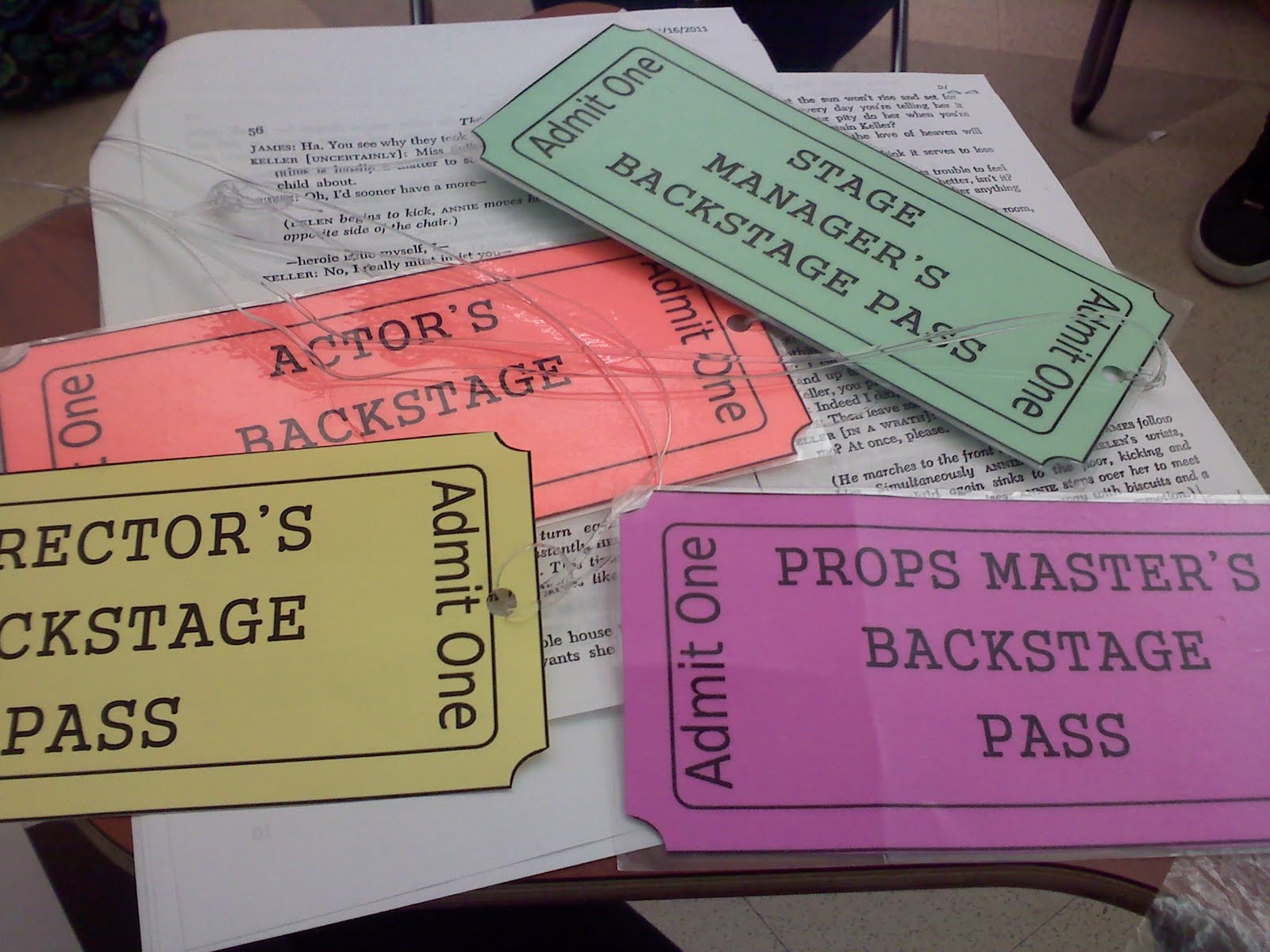
For the students' final assessment, Ms. G divides the students into groups of four or five. Then, she lets the students choose which roles they want. (Throughout the unit, Ms. G spends time teaching the students about the different theater roles, such as prop master and director, so that by the time they are ready to complete their final assessment, they understand each of the roles and can choose the one they want.) Once all of the students have their roles Ms. G passes out "Admit One" backstage passes with the name of their role and its description (see above picture).

I would love to adapt this final project in my classroom for teaching Shakespearean plays as well!

Wednesday, February 16, 2011

The Hunger Games Challenge


Taylor Swift, Katy Perry...Suzanne Collins? It may seem odd, but Young Adult Literature author, Suzanne Collins, was nominated by Entertainment Weekly as one of the top entertainers of 2010 right alongside Taylor Swift and Katy Perry. Odd? Perhaps. Awesome? Definitely! Oh yeah, and Stieg Larsson was also on the list of top entertainers as well. (If you're unfamiliar with Larsson, he is the Swedish author who died in 2004, whose crime novels were published posthumously in the United States---The Girl With the Dragon Tattoo, The Girl Who Played With Fire, and The Girl Who Kicked the Hornet's Nest.)

Last semester while I was student teaching, I shared this information with my students and they wanted to learn more about Suzanne Collins. What books has she written? What are her novels about? Her Hunger Games trilogy is making Collins into a household name. (She has already written a screenplay for the novel to be turned into a movie.)

In order to share my Hunger Games obsession with Sigma Tau Delta members, I created "The Hunger Games Challenge," in which I have challenged all of our Sigma Tau Delta members to read the first novel in the trilogy, The Hunger Games, by April 27th. I feel as if Young Adult Literature gets a bad rep; often it isn't considered "real" Literature with a capitol L. However, my goal is to change peoples' perceptions of YA Lit and encourage them to appreciate it as its own literary genre.

If you are interested in learning a bit more about The Hunger Games, check out the Book Trailer I made for the novel.

TAKE THE CHALLENGE! READ THE HUNGER GAMES!

Monday, January 24, 2011

The Book Thief


Sadly, I must admit that I was not expecting Markus Zusak's The Book Thief to be such a compelling novel. As an English Major, I am ashamed to admit that I thought that all of the Holocaust books and Literature I read in middle school, high school, and college would provide me with enough of a grasp of the time period. I am ashamed.


Zusak's The Book Thief proved me wrong about Holocaust Literature on a multitude of levels. First of all, as a work of historical fiction (and also as a Young Adult text--although there is some controversy as to this text's classification) I was expecting the main character to be a young girl or boy. However, the entire story is narrated by "Death" and it follows Liesel, a German girl living during the Holocaust. When she is brought to live with foster p
arents who struggle to make ends meet, Liesel tries to have a carefree childhood but faces many obstacles. Although the story was narrated by Death, the other characters I read about were round, complex characters.

If you want to hear Zusak explaining his inspiration for penning The Book Thief, please watch the following YouTube video: http://www.youtube.com/watch?v=m7B8ioiZz7M
The Book Thief is a must-read! No matter how many texts you have read that take place during this time period, none can compare to the emotional rollercoater that you will experience while reading Zusak's masterpiece!

Monday, December 27, 2010

Building Up My Young Adult Lit Arsenal

Next semester at TCNJ (my final semester at TCNJ! YIKES!) I will be taking LIT 310. Translation: Lit for Young Readers with Dr. Meixer. Student teaching in a middle school this semester made me realize that I need to quickly expand my arsenal of Young Adult authors and novels so that I can provide reading recommendations to my students. This past semester, the students were the ones recommending most of the books to me! Oh the irony!

Courtesy of my students I have now grown to love Suzanne Collins and The Hunger Games trilogy. I even made my very own book trailer for the first novel, The Hunger Games, which I shared with my students. (You can view my book trailer at the following link: Ms. C's Hunger Games Book Trailer.)


Anyway, the 16 books that I will be reading with Dr. Meixner for LIT 310 are (in no particular order):
  • The Hunger Games by Suzanne Collins
  • The Book Thief by Markus Zusak
  • Love that Dog by Sharon Creech
  • Harry Potter and the Sorcerer's Stone by J. K. Rowling
  • Ella Enchanted by Gail Carson Levine
  • The Rose and the Beast: Fairy Tales Retold by Francesca Lia Block
  • Pedro and Me by Winick (a graphic novel)
  • Poetry Speaks Who I Am by Paschen (poetry anthology)
  • The Absolutely True Diary of a Part-Time Indian by Sherman Alexie
  • The Skin I'm In by Sharon Flake
  • The Outsiders by S.E. Hinton
  • Thirteen by Howe (short story collection)
  • Getting Away with Murder by Crowe
  • The Misfits by James Howe
  • The Birchbark House by Louise Erdrich
  • Esperanza Rising by Pam Munoz Ryan
I've already read a bunch of these novels, but I'm looking forward to reading them from a new perspective: that of a future English teacher. I particularly like how the novels span from elementary level texts to high school level texts.

I'm especially excited to read Markus Zusak's The Book Thief. My former seventh and eighth grade students will be reading that novel in the spring.

It's safe to say I will definitely add to my YA Lit arsenal after taking this class.

Wednesday, December 15, 2010

Digital Book Trailers


I am so proud of my students for creating incredible digital book trailers for their last Book Talks. Rather than forcing the students to all write a summary of the book to share with the class, I let the students unleash their creativity for this assignment. Click on the following link to view one of my student's incredible book trailers:


Sunday, November 28, 2010

Mull and Shusterman at NCTE


At the NCTE Convention in Orlando, one of my favorite sessions that I attended was an Author Strand session, featuring Young Adult authors, Brandon Mull and Neal Shusterman. Click on the above video link to watch a clip of Neal Shusterman reading the opening pages from his novel, Bruiser.

Afterwards, I had the pleasure of meeting Brandon Mull and Neal Shusterman, both of whom signed copies of their books for me. I was even lucky enough to receive an advance copy of Mull's newest novel, Beyonders, which isn't scheduled for publication until 2011.

Brandon Mull signing a copy of Beyonders for me.

Neal Shusterman signing a copy of Everlost for me.

Monday, November 15, 2010

Countdown to NCTE Orlando

Only three more days until sunny Orlando for four magical days of professional development in the heart of Disney! Now that I have flipped through the nearly 400-page digital convention booklet, I have determined which sessions I most want to attend. Below is what my tentative NCTE Orlando schedule looks like for the first two days of the convention:


NCTE 2010

Orlando (11/18-11/21)

Thursday, November 18th

- Check-in at Disney Caribbean Beach Resort. Take shuttle to Disney Coronado Springs for Convention.

- Universal Studios after 2pm

- Harry Potter movie marathon 6pm-3am


Friday, November 19th

9:30am-10:45am

A. 06: Building Teacher Communities Through Social Networking (pg. 55)

11:00am-12:15pm

B. 25: Author Strand: Brandon Mull and Neal Shusterman (pg. 74)

B. 52: A Look in the Rearview Mirror: What Did and Didn’t Work in a Pre-Service English Education Program (pg. 80)

12:00pm-6pm (ongoing)

Coronado/Veracruz Exhibition Hall

12:30pm-1:45pm

C. 22: Putting Art into Language Arts

4:00pm-5:15pm

E. 34: Beyond Graphic Novelty: Transforming the Hype into Powerful Practice


Saturday, November 13, 2010

Getting Pumped for NCTE Orlando

In five days I will be taking a mini break from student teaching in order to attend a major professional development convention in Orlando, Florida. Last year, one of the most significant choices I made in advancing my professional career was to join NCTE, the National Council of Teachers of English. I attended their 2009 Annual Convention in Philadelphia, at which I attended excellent workshops on learning how to teach graphic novels, how to integrate technology in the classroom, and how to use reading strategies to enhance comprehension. Over the past several days, I have been eagerly flipping through the online program, attempting to narrow down my session choices for this year's convention. There are so many seminars I would like to attend, some of which include: Building Teacher Communities Through Social Networking, Author Strand with Brandon Mull and Neal Shusterman, and Putting Art into Language Arts.

One of the greatest resources available to English teachers at this convention, is the Exhibition Hall, in which publishers from companies such as Scholastic and Random House, bring advance copies of Young Adult Literature texts, which they willingly distribute to the teachers. Many times throughout my student teaching experience I have been able to foster a love of reading for my students by loaning them books that I received at last year's convention. Avid readers, they eagerly soak up new materials, constantly asking for more suggestions. Hopefully after this year's convention I will be able to bring back new books and new choices for my students.

Saturday, October 30, 2010

Using Technology in the Classroom

I decided to add to my original introductory lesson for The Watsons Go to Birmingham, 1963, by creating my very own video using Windows Movie Maker. I put together clips from the 1960s race riots and social injustice, hoping to construct an idea of the time period with my students. You can view my video at this link: Watsons Introduction.

Luckily, my classroom is equipped with a working projector and computer, so I can integrate technology into my lessons. I try not to let the technology run my lessons; rather, I use technology to enhance my lessons.

For example, when I completed a mini nonfiction unit with my students, I used the computer in my room as a means of projecting nonfiction articles onto the screen, so my students could follow along as we dissected characteristics of nonfiction texts. I will continue to integrate technology into my classroom during my next unit as well.

Friday, October 29, 2010

Planning Meaningful Assessments


At this point in the semester, I am eight weeks into my student teaching experience--with a mere seven weeks remaining. Thus far we have read stories by O. Henry and Poe, and we have practiced "Talking to the Text," which reinforces reading strategies the students learned in sixth grade. I cannot help but wonder:
  • Have I made an impact in my students' lives?
  • Will they remember what I've taught them?
  • Will they take information from my class and apply it elsewhere?
One of the best ways to help students retain information is by providing them with meaningful assessments--assessments in which they can create, analyze, and synthesize. Meaningful assessments give students a purpose for completing an assignment. Rather than simply completing the task for a grade, students make the task purposeful.

In my attempts at helping students discover a purpose f
or each unit, I have developed assessments that move beyond basic recall questions. For example, at the end of the O. Henry short story unit the students created their own short stories using similar plot structure. The following units that I will
be completing with the students revolve around the following texts: The Watsons Go to Birmingham, 1963 and To Kill a Mockingbird.

At the end of the Watson Unit, I was thinking of having the students create a journal for one of the characters, in which they describe the various settings, conflicts, and characters of the text, building upon the elements of fiction that we p
reviously discussed during our short story units.

As for the TKAM Unit, I am still unsure as to how I want to assess the students, yet make it meaningful at the same time. Any suggestions?

Photo courtesy of scholastic.com

Sunday, October 17, 2010

Learning Stations

I have found that the most successful activity I have implemented during student teaching thus far have been my Edgar Allan Poe Learning Stations. The following is how I structured my lessons:

1. In their journals, students created a KWL chart about Poe, filling in the "K" column (what they know). Then, as a class, we shared answers and filled in the "W" column (what they want to know). I have a computer and projector in my room so I was able to project this chart onto the board while we added to it.

2. Then, we read a short biography about Poe and filled in parts of the "L" column (what they learned about Poe).

3. Separating the students into six groups, I then presented an overview of each station to the students:
- "The Black Cat" station = theme
- "The Fall of the House of Usher" station = setting
- "The Raven" station = tone and mood
- "The Tell-Tale Heart" station = talking to the text (using reading strategies)
- "The Cask of Amontillado" station = characterization
- "The Pit and the Pendulum" station = plot development

The students would rotate every 25 minutes, and I think they really enjoyed moving around from station to station. This is only my second time experimenting with Learning Stations in the classroom, but the students seem to be responding to it well.

Stay tuned for more to come from the secondary ed English classroom!